

Conservation Enterprises
Conservation enterprises approaches are defined by a development hypothesis (theory of change) that if income is increased through conservation enterprises, then participants will be motivated and enabled to change behaviors to reduce threats to biodiversity (e.g., by reducing unsustainable resource use or monitoring/excluding others).
Over the past two decades, conservation enterprise approaches have been used extensively in USAID biodiversity programming. Yet, little information has been collected in a systematic way to test key assumptions regarding the effectiveness of these approaches. This group can gain a deeper understanding of the effectiveness of conservation enterprises by exploring a set of shared learning questions focused on the theory of change. Explore the Conservation Enterprise Learning Agenda .
What You Can Do Here





What’s New
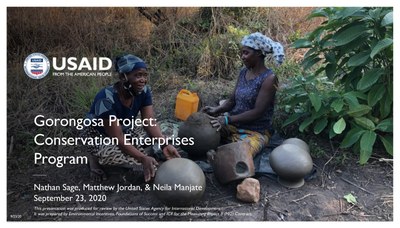
Webinar Presentation: Gorongosa Project Conservation Enterprises
Working with approximately 200,000 people living in Mozambique’s Gorongosa National Park buffer zone, the USAID Integrated Gorongosa and Buffer Zone Program seeks to leverage…
Webinar Recording: Gorongosa Project Conservation Enterprises
Working with approximately 200,000 people living in Mozambique’s Gorongosa National Park buffer zone, the USAID Integrated Gorongosa and Buffer Zone Program seeks to leverage…
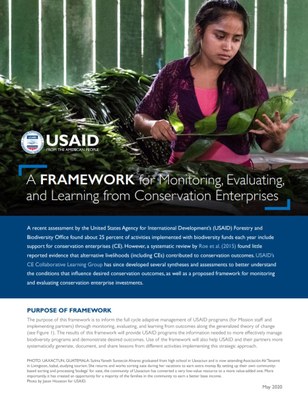
A Framework for Monitoring, Evaluating, and Learning from Conservation Enterprises
The Conservation Enterprise Learning Group developed a MEL framework for USAID and Implementing Partner staff to use to inform the adaptive management of their…
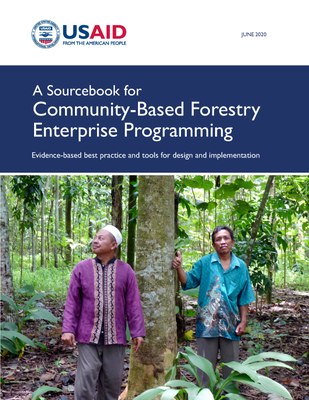
A Sourcebook for Community-Based Forestry Enterprise Programming
This Sourcebook aims to inform design and implementation of community forestry interventions that seek to deliver social, environmental, and economic outcomes in developing countries.…
Webinar Presentation: Community Forest Management in Peru
More than 400,000 indigenous people live in the Peruvian Amazon, many of whom live in vulnerable conditions due to a combination of extractive industries,…