
Sustainable Intensification + Integrating High Production USAID RMP Search
Africa Biodiversity Collaborative Group Annual Report 2019
Together with our partner networks, ABCG continues to create innovative conservation solutions by developing new models for collaboration that help practitioners improve, scale, and replicate. By capturing and conveying conditions needed for successful biodiversity conservation, ABCG serves as a dynamic…
ENVIRONMENTALLY SOUND DESIGN (ESD) SECTOR ENVIRONMENTAL GUIDELINES SMALL-SCALE DRYLAND AGRICULTURE
ENVIRONMENTALLY SOUND DESIGN (ESD) SECTOR ENVIRONMENTAL GUIDELINES: SMALL-SCALE DRYLAND AGRICULTURE This document presents one sector of the Sector Environmental Guidelines prepared for USAID under the Agency’s Global Environmental Management Support Project (GEMS). All sectors are accessible at www.usaidgems.org/bestPractice.htm. The purpose…
Making Gender Count: Leveraging M&E to Mainstream Gender
South Asia is one of the most water-scarce regions of the world. The Himalayan river basins that supply much of the region’s water, traverse national boundaries and are under increasing pressure due to industrialization, urbanization and a rapidly-growing population. Water…
Shifting Cultivation, Gender, and REDD+ in Cameroon and The Democratic Republic Of Congo: Annexes
REDD+–Reducing Emissions from Deforestation and Forest Degradation and the role of conservation, sustainable management of forests, and enhancement of forest carbon stocks–is a major global initiative that aims to reduce greenhouse gas emissions while improving rural livelihoods and governance. The…
Final Report: Forest Carbon, Markets and Communities (FCMC) Program
Tetra Tech was awarded the three-and-one-half year Forest Carbon, Markets, and Communities Program (FCMC) Task Order (TO) by the United States Agency for International Development (USAID) in late March 2011. No-cost extensions enabled the program to continue through August 2015.…
Supporting REDD+ in Developing Countries: A Review of Policy Options
The objective of this paper is to evaluate the potential of a range of market and non-market policy options available to developing countries willing to contribute to a global climate change solution by reducing emissions from deforestation and forest degradation,…
(MI) Measuring Impact: Lessons Learned from the Forest, Climate and Communities Alliance
MI is a five-year USAID project executed by the E3/FAB Office designed to improve the Agency’s practice of conservation by building USAID’s capacity to better design, manage, evaluate, and learn from biodiversity conservation initiatives. As such, MI was tasked with…
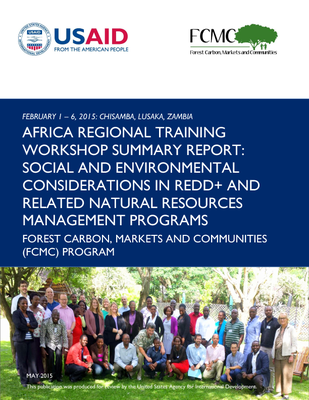
Africa Regional Training Workshop Summary Report: Social and Environmental Considerations in REDD+ and Related Natural Resources Management Programs
The Africa Regional Training Workshop on Social and Environmental Considerations in reducing emissions from deforestation and forest degradation and the role of conservation, sustainable management of forests and enhancements of forest carbon stocks (REDD+) Programming and Implementation was conducted from…
Manuel de mesure, notification et verification (MNV) de la REDD+ version 2.0
La réduction des émissions résultant de la déforestation et de la dégradation des forêts, de la conservation des stocks de carbone, de la gestion durable des forêts et du renforcement des stocks de carbone forestier (REDD +) est devenue un…
Biodiversity Conservation: A Guide for USAID Staff and Partners
Biodiversity conservation is an evolving, dynamic field, and this Guide serves as a starting point to shape and guide programs or activities that should ultimately be implemented based on local environmental and socioeconomic conditions and capacity of im
Land, Power, and IdentIty: Roots of Violent Conflict in Eastern DRC
This study examines access to, use of and management of land and its links with the root causes of conflict in the two Kivu provinces and Ituri in the Democratic Republic of Congo (DRC). The study’s aim is to identify…
Supporting Zero-Deforestation Cattle in Colombia
Colombia is among the world’s top cattle-producing countries, with more than 23 million head of beef and dairy cattle occupying approximately 38 percent of the total land area. It is challenging to clearly correlate deforestation with specific agricultural commodities in…
REDD+ Measurment, Reporting and Verification (MRV) Manual Version 2.0
The purpose of this Manual is to provide an overall review of the data, models, techniques and accounting methods that could be part of a Measurement, Reporting and Verification (MRV) system for reducing emissions from deforestation and forest degradation and…
Workshop Report: Shifting Cultivation, Gender and REDD+ in West and Central Africa
In July 2012, FCMC hosted a workshop in Washington, DC to act as the starting point for its study on Shifting Cultivation, Deforestation, Gender and REDD+. The workshop discussed ongoing work with shifting cultivation in West and Central Africa, primarily…
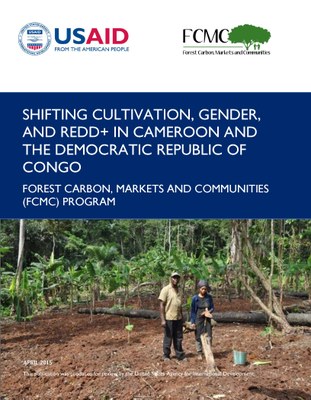
Shifting Cultivation, Gender, and REDD+ in Cameroon and the Democratic Republic of the Congo PDF
Shifting cultivation – also called swidden, slash-and-burn, or rotational cultivation – is the natural resource management system that underpins food production and livelihoods in the forest zones of Central African countries. It has been identified as a key driver of…
Eastern Africa – Forest Carbon Projects Study
This study analyzes four forest carbon projects in Eastern Africa and aims to better understand the challenges and successes of such projects that combine climate change, biodiversity conservation and community development objectives.
Key Findings and Opportunities for REDD+ in Ecuador: An Abbreviated Summary of the Comprehensive Report
In December 2011, a team of experts conducted an integrated assessment of REDD+ Readiness in Ecuador, evaluating the country’s infrastructure and policies surrounding all four technical areas of the FCMC program—Social and Environmental Soundness; Finance and Carbon Markets; Measurement, Reporting…
REDD+ et conservation de la biodiversité : Approches, expériences et possibilités d’améliorer les résultats
Ce rapport examine comment les questions de biodiversité sont abordées aujourd’hui dans les politiques et les cadres existants en matière de sauvegardes dans les activités de programmes et de projets de carbone forestier nationaux, et formule des recommandations sur la…
REDD+ and Biodiversity Conservation: Approaches Experiences and Opportunities for Improved Outcomes
This report reviews how biodiversity issues are currently being addressed in existing safeguard policies and frameworks, national programs and forest carbon project activities, and provides recommendations on how to ensure positive biodiversity impacts in emerging REDD+ initiatives. This synthesis report…
A Review of the Biodiversity Goals and Proposed Monitoring Methods in National REDD+ Programs
This study reviews documents developed early in the REDD+ readiness process to explore how emerging national-level REDD+ programs are addressing biodiversity issues.