

Fisheries Training
Biodiversity Reference Sheet
Ecosystems provide goods and services critical to human development and well-being such as food, fiber, clean water, fertile soil and pollination. Opportunities for integrating biodiversity with other development sectors exist throughout the USAID portfolio, and can be realized by the…
Food Security Reference Sheet
Ecosystems provide goods and services that support food production—including provision of wild foods and water, pest control and pollination—and biodiversity programming can have significant positive impacts on food security. Similarly, agriculture programming can sustainably increase productivity and incomes while minimizing…
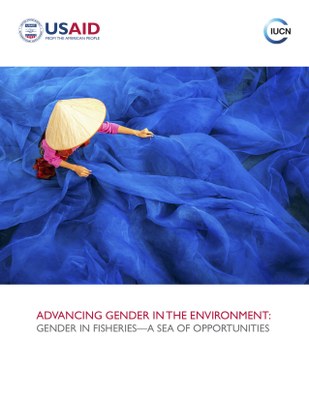
Advancing Gender in the Environment: Gender in Fisheries—A Sea of Opportunities
Produced by USAID’s Office of Gender Equality and Women’s Empowerment (GenDev), USAID’s Office of Forestry and Biodiversity (FAB), and the International Union for Conservation of Nature (IUCN), the guide provides an overview of the unique roles and contributions women make…
USAID Biodiversity Conservation and Forestry Programs, Fiscal Year 2017 Annual Report
USAID Biodiversity Conservation and Forestry Programs, Fiscal Year 2017 annual report.
Democracy, Human Rights and Governance and Biodiversity Conservation Linkages
This document provides examples of how and where USAID has advanced democracy, rights, and governance (DRG) objectives—such as participation, inclusion, transparency, and accountability. USAID’s approaches include promoting co-management approaches; tackling environmental crime and wildlife trafficking; strengthening the legal and judicial…
Integrating Food Security and Wild Caught Fisheries Management in USAID Programming
Integrating Food Security and Wild Caught Fisheries Management in USAID Programming is an illustrative case example that demonstrates how two adaptive management programming tools—situation models and results chains—can help USAID staff and its partners to better design and implement activities…
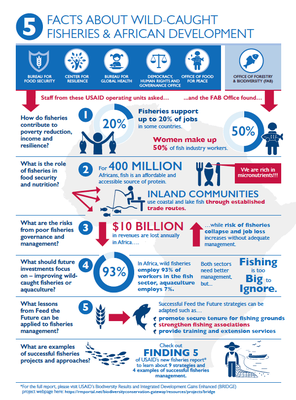
Five Facts About Wild-Caught Fisheries & African Development
Infographic about Wild-Caught Fisheries & African Development
Partnership for the Conservation of Amazon Biodiversity Annual Report 2017
In 2017, PCAB activities covered an area of 56 million hectares, providing direct economic benefits to more than 4,000 people and indirectly benefiting thousands. In the coming years, we would like to expand this partner network even further and increase…

Virtual Fisheries Academy
Environmental Defense Fund’s Virtual Fisheries Academy is an online learning center with free, interactive e-courses on fishery management topics. Current courses cover three topics: Introduction to Fisheries Management, Territorial Use Rights for Fishing, and Data-Limited Fisheries Management. The Virtual Fisheries…
Americans with Disabilities Act Compliant Version of Acting on the Evidence
Download this file for an accessible version of Acting on the Evidence, the interactive learning resource for Evidence in Action.
How Does Developing Enforcement Capacity Reduce Wildlife Crime?
“How Does Developing Enforcement Capacity Reduce Wildlife Crime?” summarizes findings from the literature around four key assumptions about capacity building for enforcement and prosecution. Using the experiences and evidence summarized in this brief, program designers and implementing partners should be…
The Role of Wild-Caught Fisheries in African Development
This report on the role of wild-caught fisheries in African development focuses on small-scale fisheries in East and West Africa. The report describes the role of wild-caught fisheries in food security, resilience and nutrition and presents opportunities and recommendations for…
The transboundary displacement of deforestation under REDD+: Problematic intersections between the trade of forest-risk commodities and land grabbing in the Mekong region
The fragmentary adoption of REDD+ across forest nations leaves room for the displacement of deforestation from early-adopters and countries with more rigorous carbon-related regulatory regimes to late-adopters of REDD+. While this displacement is expected to be substantial, our empirical understanding…
Compiled – CWT Synthesis and Cases
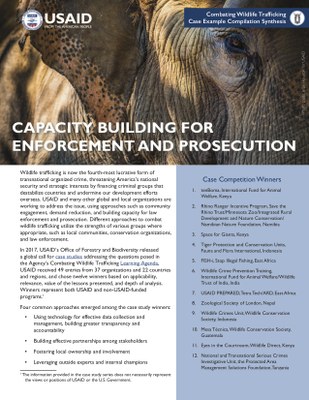
USAID launched a global case study compilation to collect lessons on an urgent global conservation challenge: how to build capacity for enforcement and prosecution to combat wildlife trafficking. Forty-eight entries were received, and 12 of these were selected for publication…
Wildlife Crimes Unit in Indonesia
Wildlife Conservation Society’s Wildlife Crimes Unit takes a unique approach to combat wildlife trafficking in Indonesia. The Unit performs intelligence work, assists law enforcement, helps build capacity for combating wildlife trafficking among law enforcement officers, and raises public awareness through…
FISH-i in East Africa
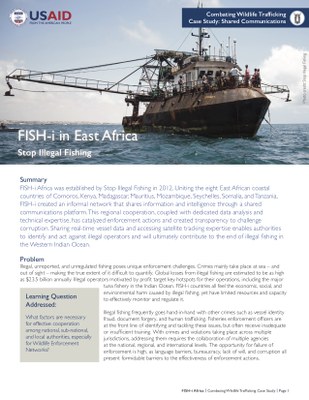
Established in 2012, FISH-i created an informal network that shares information and intelligence through a shared communications platform. This regional cooperation, coupled with dedicated data analysis and technical expertise, has catalyzed enforcement actions and created transparency to challenge corruption. Sharing…
SECTOR ENVIRONMENTAL GUIDELINE CONSTRUCTION Full Technical Update 2017
This document presents one sector of the Sector Environmental Guidelines (SEGs) prepared for United States Agency for International Development (USAID) under the Agency’s Global Environmental Management Support (GEMS) program. All sectors are accessible at http://www.usaidgems.org/sectorGuidelines.htm. Purpose. The purpose of this…
USAID GLOBAL ENVIRONMENTAL MANAGEMENT SUPPORT (GEMS) SECTOR ENVIRONMENTAL GUIDELINE: ARTISANAL AND SMALL-SCALE MINING
This document presents one sector of the Sector Environmental Guidelines (SEGs) prepared for United States Agency for International Development (USAID) under the Agency’s Global Environmental Management Support (GEMS) program. All sectors are accessible at http://www.usaidgems.org/sectorGuidelines.htm. Purpose. The purpose of this…
Solving the Mystery of Marine Protected Area Performance: Monitoring social impacts
Solving the Mystery of Marine Protected Area Performance: Monitoring Social Impacts (Field Manual)